Bagna càuda (Bunyacotta). Great recipe for Bagna càuda (Bunyacotta). This is a family recipe from when i was a child. Everyone would hover over the pan, waiting for grandpa to finish.
 La bagna caoda è un intingolo tentatore, da gustare per fortuna in autunno, quando la stagione invernale si approssima e porta con sé ampi maglioni… Provatelo con le patate lesse, i cardi gobbi di Nizza, il cavolo, il sedano, le cipolle e gli immancabili peperoni, ma anche con la carne: non lo dimenticherete!
The dish is served and consumed in a manner similar to fondue, sometimes as an appetizer, with raw or cooked vegetables typically used to dip into it.
Everyone would hover over the pan, waiting for grandpa to finish.
La bagna caoda è un intingolo tentatore, da gustare per fortuna in autunno, quando la stagione invernale si approssima e porta con sé ampi maglioni… Provatelo con le patate lesse, i cardi gobbi di Nizza, il cavolo, il sedano, le cipolle e gli immancabili peperoni, ma anche con la carne: non lo dimenticherete!
The dish is served and consumed in a manner similar to fondue, sometimes as an appetizer, with raw or cooked vegetables typically used to dip into it.
Everyone would hover over the pan, waiting for grandpa to finish.
Surprisingly this is an easy recipe just in the same way as the extra ones. I think the hardest share is to locate the best ingredients as a result you can enjoy the appetizing Bagna càuda
(Bunyacotta) for your breakfast with your friends or family.
You can have Bagna càuda
(Bunyacotta) using 6 ingredients and 10 steps. Here is how you cook that.
Ingredients of Bagna càuda (Bunyacotta)
- Prepare 2 stick of salted butter.
- Prepare 2 can of flat anchovie fillets in olive oil.
- You need 1 head of garlic.
- Prepare 1/4 cup of Half and Half, less if needed to color.
- Prepare 1 loaf of crusty french bread or similar.
- It's 1 head of cabbage.
And he would shoo us away. Once he was done, it was a madd fight to get to this stuff. La bagna cauda, o bagna caoda, è una ricetta tipica piemontese e per gli abitanti della regione è sacra! Si tratta di uno di quei classici piatti conviviali che sono perfetti per riunire attorno a un tavolo amici e famigliari, ed essendo molto ricca e sostanziosa si gusta come piatto unico.
Bagna càuda (Bunyacotta) instructions
- Slice garlic thinly, i use a razor blade. But just make sure its as thin as possible. Yes, use the entire head..
- Place garlic in sauce pan and add 2 sticks of butter. It is crucial that you keep the temp as low as possible to prevent the butter from seperating..
- You will simmer this for quite awhile. The goal is to have the garlic break down as much as possible. I would say at least 1/2 to 1 hour. Keep stirring and watch the heat..
- After the garlic seems broken down, drain the olive oil from the anchovies and add the fillets to the garlic butter mixture. Try and seperate the fillets as you add them. This will help them break down as well..
- Continue to cook on very low until the anchovies have broken down. You should now have a brownish sauce..
- Now add the 1/2 and 1/2 little by little until the mixture is a lighter color. You still want this brown, but a lighter creamier brown. So add a little at a time until it looks good. You may use more or less depending on your tastes. The darker the sauce, the richer it is..
- Peel off leaves of cabbage and set in a pile..
- Slice up the bread into 2 inch x 3 inch pieces. Or to your taste..
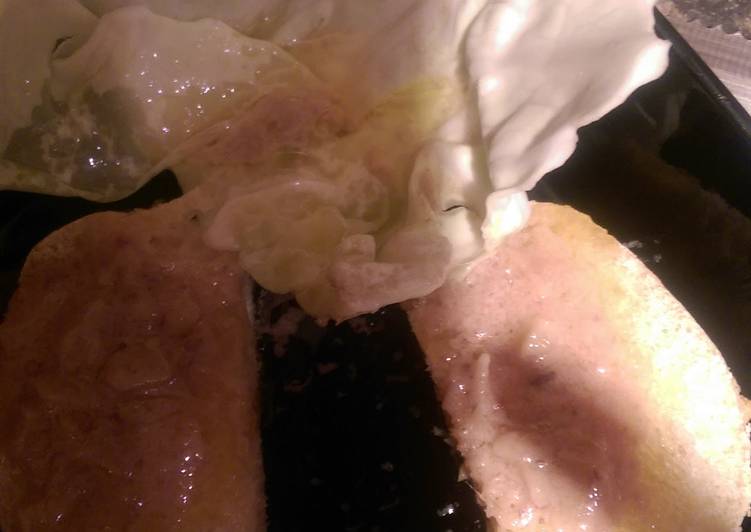
- Use the cabbage to scoop the sauce out of the sauce pan. While holding the cabbage with the sauce pooling in it, hold over the bread and eat. The drippings will fall onto the bread and then eat the bread. Of course you could just dip the bread in the sauce if you choose. But this is my familys tradition..
- This does keep well in a container to reheat later if desired. If it doesnt get eaten up..
La bagna càuda è una preparazione a base di aglio e acciughe dissalate e diliscate, cotta a fuoco lento in olio extravergine d'oliva, riducendo il tutto a salsa. Si consuma intingendovi vari tipi di verdure di stagione solitamente divise tra crude e cotte: cardi, cipolle cotte al forno, peperoni crudi o abbrustoliti, foglie di cavolo crude, cavolfiore, topinambur, barbabietole, patate cotte. La bagna cauda è un piatto unico, tipico della cucina piemontese. Il suo nome deriva dal dialetto in cui "bagna" significa sugo o salsa, mentre "cauda" vuol dire calda. La salsa calda, come indica il nome stesso, è un intingolo sostanzioso a base di acciughe, latte e aglio, in cui vengono intinte verdure sia cotte, come patate, cipolle, barbabietole, sia crude come i cardi e i cipollotti.
I will just inform you that recipe already tested by team, you helpfully follow all the cooking instructions and prepare the ingredients to acquire the savory Bagna càuda (Bunyacotta). If you have questions or requests on the subject of this article, make smile open us as soon as possible. And don't forget to bookmark this page appropriately you will easily locate it over later. The content source: https://cookpad.com
